Home
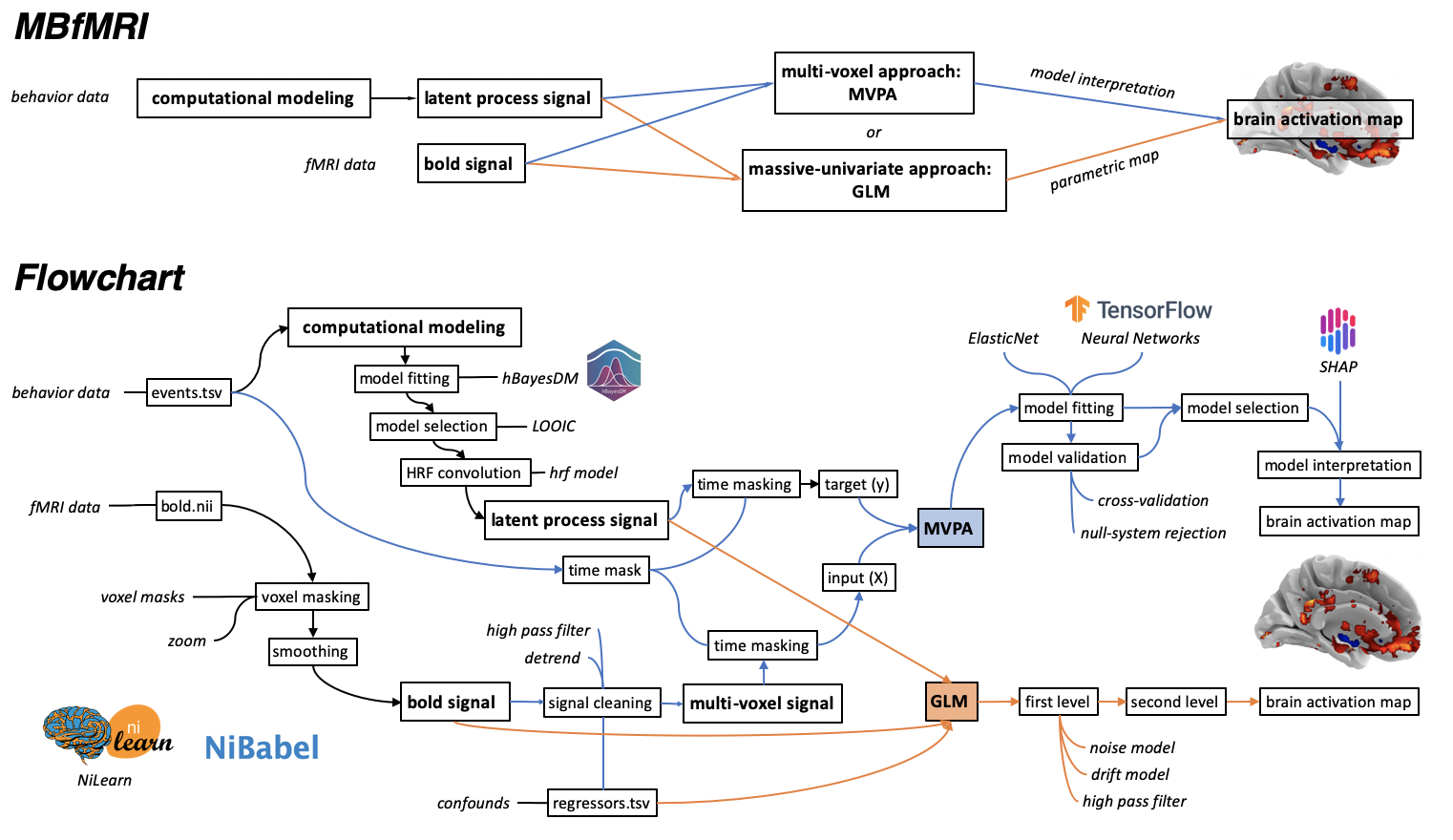
MBfMRI is a unified Python fMRI analysis tool on task-based fMRI data to investigate brain implementations of latent neurocognitive processes. MBfMRI offers simple executable functions to conduct computational modeling (supported by hBayesDM [1]) and run model-based fMRI analysis. It is featured by a new analytic framework adopting multi-voxel pattern analysis (MVPA).
The analysis is based on the framework of model-based fMRI by O’Doherty et al.(2007) [2].
Find best fitting parameters of model to behavioral data
Generate model-based time series by using the best model-fitting parameters and convolve it with HRF (a.k.a. latent process)
Relate latent process with task-fMRI data
For the step 3), the prevailing method in model-based fMRI analysis is based on Generalized Linear Model (GLM), a massive univariate approach followed by parametric mapping (GLM approach). Upon the GLM approach, MBfMRI extends the framework by adopting MVPA regression models (MVPA approach). The MVPA approach has the following features compared to the previous GLM approach: (1) MVPA regression models predict cognitive process directly from brain activations, enabling acquisition of reverse inference model denoted by Poldrack (2006) [3]. (2) instead of mapping statistical significance, the brain activation pattern correlated with the latent process is obtained by interpreting trained MVPA regression models. (3) model-based MVPA is flexible as it allows various MVPA models plugged in and (4) it is free of analytic hierarchy (e.g. first-level anal. or second-level anal.).
The specific workflow of the model-based MVPA approach consists of the following steps.
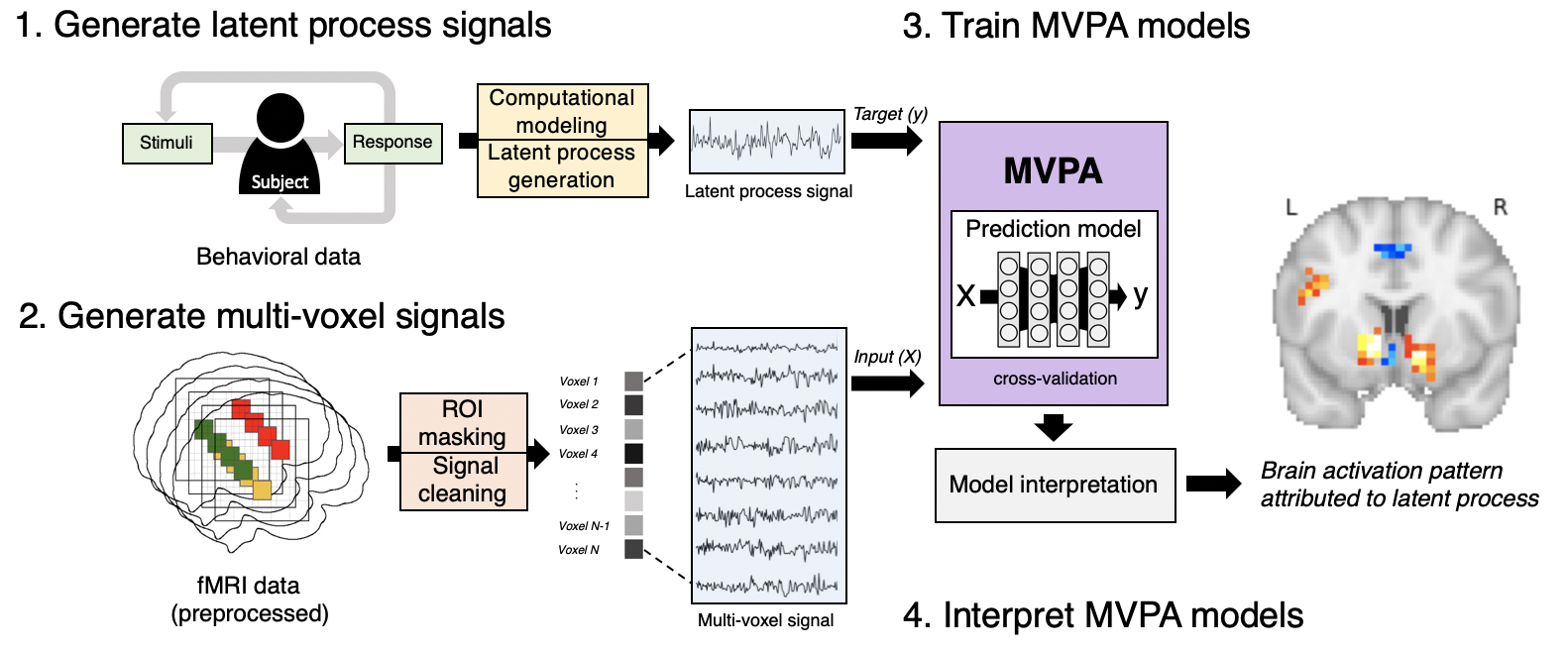
Generate latent process signals by fitting computational models with behavioral data and convolving time series of latent process with HRF.
Generate multi-voxel signals from preprocessed fMRI images by allowing ROI masking, zooming spatial resolution, and improving the quality of signals by several well-established methods (e.g., detrending, high-pass filtering, regressing out confounds).
Train MVPA models by feeding multi-voxel signals as input (X) and latent process signals as output (y), or target, employing the repeated cross-validation framework.
Interpret the trained MVPA models by Feature Attribution method, and obtain a 3D brain image that quantifies brain activation pattern attributed to predict the target signals from the multi-voxel signals.
The package also provides the existing model-based GLM approach. The process shared with the model-based MVPA approach is 1) Generate latent process signals to provide parametric modulation of the target signals. The first-level and second-level analysis are done by NiLearn modules, FirstLevelModel and SecondLevelModel respectively. Please refer to the links if you’d like to know the details about each step.
MBfMRI supports Python 3.6 or above and relies on NiLearn, hBayesDM, py-glmnet, and tensorflow (tested on v2.4.0).
Examples
from mbfmri.core.engine import run_mbfmri
import hbayesdm

_ = run_mbfmri(analysis='mvpa',                     # name of analysis, "mvpa" or "glm"
               bids_layout='mini_bornstein2017',    # data
               mvpa_model='elasticnet',             # MVPA model, "mlp" or "cnn" for DNN
               dm_model= 'banditNarm_lapse_decay',  # computational model
               feature_name='zoom2rgrout',          # indentifier for processed fMRI data
               task_name='multiarmedbandit',        # identifier for task
               process_name='PEchosen',             # identifier for target latent process
               subjects='all',                      # list of subjects to include
               method='5-fold',                     # type of cross-validation
               report_path=report_path,             # save path for reporting results
               confounds=["trans_x", "trans_y",     # list of confounds to regress out
                          "trans_z", "rot_x",
                          "rot_y", "rot_z"],
               n_core=4,                            # number of core for multi-processing in hBayesDM
               n_thread=4,                          # number of thread for multi-threading in generating voxel features
               overwrite=True,                      # indicate if re-run and overwriting are required
               refit_compmodel=True,                # indicate if refitting comp. model is required
              )
Please refer to the documentation of mbfmri.core.engine.run_mbfmri, and you will find links for the detailed explanation on configuring analysis on the bottom of run_mbfmri docs.
Content
References
[1] Ahn, W.-Y., Haines, N., & Zhang, L. (2017). Revealing Neurocomputational Mechanisms of Reinforcement Learning and Decision-Making With the hBayesDM Package. Computational Psychiatry, 1(Figure 1), 24–57. https://doi.org/10.1162/cpsy_a_00002
[2] O’Doherty, J. P., Hampton, A., & Kim, H. (2007). Model-based fMRI and its application to reward learning and decision making. Annals of the New York Academy of Sciences, 1104, 35–53. https://doi.org/10.1196/annals.1390.022
[3] Poldrack, R. A. (2006). Can cognitive processes be inferred from neuroimaging data? Trends in Cognitive Sciences, 10(2), 59–63. https://doi.org/10.1016/j.tics.2005.12.004